<?xml version="1.0" encoding="utf-8"?><feed xmlns="http://www.w3.org/2005/Atom" ><generator uri="https://jekyllrb.com/" version="4.3.4">Jekyll</generator><link href="https://openleafsupport.github.io/feed.xml" rel="self" type="application/atom+xml" /><link href="https://openleafsupport.github.io/" rel="alternate" type="text/html" /><updated>2026-04-18T09:12:12+00:00</updated><id>https://openleafsupport.github.io/feed.xml</id><title type="html">OpenLeaf</title><subtitle>Thoughts on reading, attention, and deliberate living</subtitle><author><name>OpenLeaf (Anonymous)</name><email>openleaf.support@gmail.com</email></author><entry><title type="html">Not Quite Dead Yet Book Review: A Thriller About Survival and Identity</title><link href="https://openleafsupport.github.io/book-reviews/2026/04/12/Not-Quite-Dead-Yet-Book-Review-A-Thriller-About-Survival-and-Identity.html" rel="alternate" type="text/html" title="Not Quite Dead Yet Book Review: A Thriller About Survival and Identity" /><published>2026-04-12T00:00:00+00:00</published><updated>2026-04-12T00:00:00+00:00</updated><id>https://openleafsupport.github.io/book-reviews/2026/04/12/Not-Quite-Dead-Yet-Book-Review-A-Thriller-About-Survival-and-Identity</id><content type="html" xml:base="https://openleafsupport.github.io/book-reviews/2026/04/12/Not-Quite-Dead-Yet-Book-Review-A-Thriller-About-Survival-and-Identity.html"><![CDATA[<blockquote>
  <p><strong>Author:</strong> Holly Jackson<br />
<strong>Rating:</strong> 7/10<br />
<strong>Genre:</strong> Thriller / Mystery / Young Adult<br />
<strong>Reading Time:</strong> ~3-5 days<br />
<strong>Verdict:</strong> A gripping psychological premise that leans more on emotional tension than plot twists, though not all threads feel fully realized that how a patient with cronic brain injury can do many things. For me its a <strong>one-time-read</strong> book
<a href="https://amzn.to/4syLiA9">Buy <em>Not Quite Dead Yet</em> on Amazon (affiliate link)</a></p>
</blockquote>

<h2 id="summary">Summary</h2>

<p><em>Not Quite Dead Yet</em> tells the story of a girl who survives what should have been a fatal incident, only to find that survival itself comes with a cost. She is alive, technically. But something feels off. Not in a dramatic, supernatural way, but in subtle, unsettling shifts that make her question her own sense of reality.</p>

<p>The story unfolds through her attempt to reconstruct what actually happened. Memories feel unreliable. People around her seem slightly distant, or perhaps she is the one who has changed. Relationships that once felt solid now carry a quiet tension. The more she searches for answers, the more the story becomes less about the incident itself and more about her fragile state of mind.</p>

<p>There is a steady layering of mystery here. Clues appear, but rarely in a satisfying, linear way. Instead, the narrative mirrors her confusion. You are not just following a plot, you are sitting inside her uncertainty.</p>

<p>At its core, the book is about aftermath. What happens after survival. After the moment everyone else thinks is the end of the story.</p>

<h2 id="my-thoughts">My Thoughts</h2>

<p>What worked most for me was the emotional grounding. Holly Jackson does not rush into high-stakes drama. Instead, she lets the discomfort linger. The protagonist’s inner voice feels authentic, especially in moments where she questions her own existence.</p>

<blockquote>
  <p>“I survived. That’s what they keep saying. But it doesn’t feel like surviving.”</p>
</blockquote>

<p>That line stayed with me because it captures the entire tone of the book. Survival here is not triumphant. It is confusing. Heavy. Almost isolating.</p>

<p>The writing is clean and accessible, which works well for the genre. It keeps the story moving without getting overly descriptive. At the same time, there is enough depth to make you pause occasionally and think about what the character is going through.</p>

<p>Another strong aspect is the psychological tension. Not everything is spelled out. You are constantly trying to figure out whether something is genuinely wrong or if it is just her perception. That ambiguity is where the book shines.</p>

<blockquote>
  <p>“Everyone is looking at me like I’m still here. I’m not sure I am.”</p>
</blockquote>

<p>However, the book does stumble in a few areas. Some of the twists feel familiar, especially if you have read similar YA thrillers. There were moments where I could see certain reveals coming a bit too early. It does not ruin the experience, but it does reduce the impact.</p>

<p>The supporting characters also feel slightly underdeveloped. They serve their purpose in the story, but I rarely felt a strong emotional connection to them. Given how much the story relies on relationships shifting, this felt like a missed opportunity.</p>

<blockquote>
  <p>“Maybe the scariest thing isn’t what happened. Maybe it’s what happens after.”</p>
</blockquote>

<p>Personally, I read this over three sittings across two days. It is definitely engaging, but not in a way that makes you rush through it. I found myself slowing down at times, not because the pacing was off, but because the emotional layer made me pause and reflect.</p>

<h2 id="what-stayed-with-me">What Stayed With Me</h2>

<p>The idea that survival is not a clean ending.</p>

<p>That you can come back and still feel like you are missing pieces of yourself.</p>

<p>That memory and identity are more fragile than we like to believe.</p>

<p>There is a quiet loneliness in the story that lingers.</p>

<p>A sense that life after trauma is not about moving on, but learning to sit with what changed.</p>

<p>If you enjoy psychological thrillers that focus more on internal conflict than external action, this book will stay with you.</p>

<h2 id="final-review">Final Review</h2>

<p><em>Not Quite Dead Yet</em> is not just a mystery. It is a reflection on what it means to keep living when something inside you feels altered. While it does not completely escape familiar genre patterns, it offers enough emotional depth to make it a worthwhile read.</p>

<p>It is the kind of book that does not end loudly. It stays with you in quieter ways.</p>

<p><strong>Rating: 7/10</strong></p>

<ul>
  <li><strong>Page Turner:</strong> Yes, but more for the psychological tension than plot twists</li>
  <li><strong>Genre:</strong> Thriller, Mystery, Young Adult</li>
  <li><strong>Recommended For:</strong> Readers who enjoy introspective thrillers with emotional depth</li>
  <li><strong>Re-read Value:</strong> Medium</li>
  <li><strong>Pace:</strong> Moderate</li>
</ul>]]></content><author><name>OpenLeaf (Anonymous)</name><email>openleaf.support@gmail.com</email></author><category term="book-reviews" /><category term="thriller" /><category term="book review" /><category term="mystery" /><category term="young adult" /><category term="Holly Jackson" /><summary type="html"><![CDATA[A review of Not Quite Dead Yet, exploring how the novel blends suspense, identity, memory, and the emotional cost of survival.]]></summary></entry><entry><title type="html">How to Pick the Right Book as a Beginner (Without Overthinking It)</title><link href="https://openleafsupport.github.io/reflections/2026/04/02/How-to-Pick-the-Right-Book-as-a-Beginner-without-overthinking-it.html" rel="alternate" type="text/html" title="How to Pick the Right Book as a Beginner (Without Overthinking It)" /><published>2026-04-02T00:00:00+00:00</published><updated>2026-04-02T00:00:00+00:00</updated><id>https://openleafsupport.github.io/reflections/2026/04/02/How-to-Pick-the-Right-Book-as-a-Beginner-without-overthinking-it</id><content type="html" xml:base="https://openleafsupport.github.io/reflections/2026/04/02/How-to-Pick-the-Right-Book-as-a-Beginner-without-overthinking-it.html"><![CDATA[<p>Choosing the right book sounds simple but it rarely feels that way. You open a list. Scroll through recommendations. Save a few titles. Maybe even buy one. And then… it sits there. Unread or worse, you start it and abandon it halfway.</p>

<p>Not because the book is bad.<br />
But because it wasn’t right for <em>you</em> at that moment.</p>

<p>Over time, I’ve realized something:</p>

<p>Picking the right book is less about <em>finding the best book</em><br />
and more about <em>finding the right fit for your current mood, energy, and curiosity.</em></p>

<hr />

<h2 id="the-problem-with-top-book-lists">The Problem With “Top Book Lists”</h2>

<p>Most of us start here.</p>

<p>“Top 10 books to read this year”<br />
“Must-read classics”<br />
“Books that will change your life”</p>

<p>They are useful. But also misleading at times.</p>

<p>Because they assume:</p>
<ul>
  <li>What works for others will work for you</li>
  <li>What is popular is universally enjoyable</li>
  <li>What is important is worth your time right now</li>
</ul>

<p>In reality, reading is deeply personal. A book that someone calls life-changing might feel slow or disconnected to you. And that’s completely fine.</p>

<hr />

<h2 id="your-mood-matters-more-than-the-book">Your Mood Matters More Than the Book</h2>

<p>This is something I ignored in my younger days. I picked books based on:</p>
<ul>
  <li>Reputation</li>
  <li>Author popularity</li>
  <li>Recommendations</li>
  <li>Whatever I could get my hands on from the library, friend’s collection, etc.</li>
</ul>

<p>But I rarely asked: <em>What do I feel like reading right now?</em></p>

<p>And that’s where most mismatches happen.</p>

<p>After a long workday, your brain is not looking for:</p>
<ul>
  <li>Dense philosophy</li>
  <li>Heavy classics</li>
  <li>Complex narratives</li>
</ul>

<p>It may work for you if you have already become an avid reader but if you are just starting, it may want something engaging and easy to enter.</p>

<p>Sometimes, the right book is not the most meaningful one.<br />
It is the one you can actually <em>sit with</em> without resistance.</p>

<hr />

<h2 id="start-with-curiosity-not-obligation">Start With Curiosity, Not Obligation</h2>

<p>A simple test I now use:</p>

<p>When I look at a book, I ask: <strong>“Am I genuinely curious about this?”</strong></p>

<p>Not:</p>
<ul>
  <li>“Should I read this?”</li>
  <li>“Is this important?”</li>
  <li>“Will this make me smarter?”</li>
</ul>

<p>Just curiosity. If the answer is yes, I pick it. If not, I move on.</p>

<p>That small shift removes pressure. And when there is no pressure, reading becomes easier to sustain.</p>

<hr />

<h2 id="read-the-first-2030-pages-honestly">Read the First 20–30 Pages Honestly</h2>

<p>This is one of the most practical filters. Start the book. Read a few chapters.</p>

<p>Then ask:</p>
<ul>
  <li>Am I interested enough to continue?</li>
  <li>Do I feel like coming back to it?</li>
</ul>

<p>If the answer is no, stop. You are not quitting. You are choosing better for yourself or you may try the same book later because its all about your current mood, energy, and curiosity.</p>

<p>I’ve dropped several well-known books midway. Some of them are widely loved. But they didn’t work for me at that time. And the moment I accepted that, reading became much more enjoyable.</p>

<hr />

<h2 id="match-the-book-to-your-life-phase">Match the Book to Your Life Phase</h2>

<p>Not every book fits every phase of life.</p>

<p>There are phases where:</p>
<ul>
  <li>You want fast-paced thrillers</li>
  <li>You prefer light fiction</li>
  <li>You enjoy reflective non-fiction</li>
  <li>You revisit old favorites</li>
</ul>

<p>Trying to force a mismatch usually leads to unfinished books.</p>

<p>For example:
At times in my college days, I used to read heavy books like Kafka, Alexandre Dumas, Somerset Maugham, Somerset Maugham, etc. Those days I used to be more patient and had more time to read. But now I naturally gravitate toward more engaging books from the world of thrillers, mysteries, sweet love stories, etc. I recently bought a heavy historical analysis book by Antony Beevor on World War II, and I plan to start it once I finish my current murder mystery to change the pace. So it all depends on your current phase of life and off course mood.</p>

<p>And that’s okay.</p>

<p>Reading should adapt to your life. Not the other way around.</p>

<hr />

<h2 id="use-recommendations-but-lightly">Use Recommendations, But Lightly</h2>

<p>Recommendations are helpful. But they should be a <em>starting point</em>, not a decision.</p>

<p>When someone suggests a book, I do this:</p>
<ul>
  <li>Read the summary</li>
  <li>Check a few reviews</li>
  <li>Skim the first few pages if possible</li>
</ul>

<p>If something clicks, I go ahead. If not, I don’t force it.
Even the best recommendation fails if it doesn’t align with your interest. If I share one example: I bought Dark Matter by Blake Crouch based on a friend’s recommendation. She praised it highly, but after reading the first 50 pages, I couldn’t continue. I’m not sure why but it just didn’t click for me.</p>

<p>What’s interesting is that it has sold millions of copies on Amazon and is a bestseller. I might give it another try later.</p>

<hr />

<h2 id="my-personal-way-of-picking-books">My Personal Way of Picking Books</h2>

<p>Over time, my process has become quite simple:</p>

<ol>
  <li>I keep a loose list of books that <em>sound interesting</em></li>
  <li>When I finish a book, I don’t rush to the next one</li>
  <li>I scan that list based on my current mood. For example, if I’ve just finished a love story, I might want to switch things up with a thriller or a mystery. At other times, if I really enjoyed a book, I feel like picking up another bestseller book by the same author. It completely depends on my mood after finishing a book.</li>
  <li>I give it 20–50 pages. If I like it, I continue reading. If not, I stop.</li>
</ol>

<p>This approach has worked better than any structured system I tried earlier.</p>

<hr />

<h2 id="a-simple-way-to-choose-your-next-book">A Simple Way to Choose Your Next Book</h2>

<p>If you’re unsure what to pick next, try this:</p>

<ul>
  <li>Think of the last book you enjoyed</li>
  <li>Ask yourself <em>why</em> you liked it
    <ul>
      <li>Was it fast-paced?</li>
      <li>Emotional?</li>
      <li>Thought-provoking?</li>
    </ul>
  </li>
  <li>Look for something with a similar feel</li>
</ul>

<p>You don’t need the perfect book.</p>

<p>You just need the <em>next</em> book that keeps you reading.</p>

<hr />

<h2 id="a-closing-thought">A Closing Thought</h2>

<p>The right book doesn’t feel like effort.</p>

<p>It feels like something you return to.</p>

<p>Not because you have to.<br />
But because you want to know what happens next.</p>

<p>And once you find that feeling, even occasionally,<br />
you don’t have to worry about picking the “perfect” book anymore.</p>

<p>You just keep reading.</p>]]></content><author><name>OpenLeaf (Anonymous)</name><email>openleaf.support@gmail.com</email></author><category term="Reflections" /><category term="reading tips" /><category term="book selection" /><category term="habits" /><category term="picking books" /><summary type="html"><![CDATA[A simple, practical approach to choosing books you’ll actually enjoy and finish, based on real reading behavior and personal experience.]]></summary></entry><entry><title type="html">Verity Book Review: A Dark Psychological Thriller You Cannot Trust</title><link href="https://openleafsupport.github.io/book-reviews/2026/03/17/Verity-Book-Review-A-Dark-Psychological-Thriller-You-Cannot-Trust.html" rel="alternate" type="text/html" title="Verity Book Review: A Dark Psychological Thriller You Cannot Trust" /><published>2026-03-17T00:00:00+00:00</published><updated>2026-03-17T00:00:00+00:00</updated><id>https://openleafsupport.github.io/book-reviews/2026/03/17/Verity-Book-Review-A-Dark-Psychological-Thriller-You-Cannot-Trust</id><content type="html" xml:base="https://openleafsupport.github.io/book-reviews/2026/03/17/Verity-Book-Review-A-Dark-Psychological-Thriller-You-Cannot-Trust.html"><![CDATA[<hr />

<blockquote>
  <p><strong>Author:</strong> Colleen Hoover<br />
<strong>Rating:</strong> 9.5/10<br />
<strong>Genre:</strong> Psychological Thriller, Romance<br />
<strong>Reading Time:</strong> ~3-4 days<br />
<strong>Verdict:</strong> Unsettling, addictive, and quietly disturbing - For me its an unputdownable and <strong>must-read</strong> book 
<a href="https://amzn.to/428qWmx">Buy <em>Verity</em> on Amazon (affiliate link)</a></p>
</blockquote>

<h2 id="summary">Summary</h2>

<p><em>Verity</em> follows Lowen Ashleigh, a struggling writer who is offered a rare opportunity to complete a bestselling series for famous author Verity Crawford, who has been left unable to write after an accident.</p>

<p>Lowen moves into the Crawford home to sort through Verity’s notes and manuscripts. What she expects is research material. What she finds instead is something deeply disturbing. Hidden among Verity’s work is an unfinished autobiography filled with chilling confessions about her past, her marriage, and her children.</p>

<p>As Lowen reads further, she is pulled into a version of Verity that feels too dark to be real. At the same time, she grows closer to Jeremy, Verity’s husband, which complicates everything she is discovering.</p>

<p>The story slowly tightens around one central question.<br />
Is what she’s reading the truth, or something far more dangerous?</p>

<h2 id="my-thoughts">My Thoughts</h2>

<p>This is one of those books that hooks you early and refuses to let go.</p>

<p>What worked really well is the structure. The manuscript within the story creates a second narrative that feels invasive and uncomfortable in the best way. It’s hard to look away from it, even when you want to.</p>

<p>The writing is simple but effective. It doesn’t try to be overly clever, which actually helps the tension build naturally. The unease creeps in slowly and stays.</p>

<p>There are soo many good lines that lingered with me. A few not to mention is a crime:</p>

<blockquote>
  <p>“Truth is subjective. There’s no such thing as an absolute truth.” - so simple but so true!!</p>
</blockquote>

<blockquote>
  <p>“I don’t think you can truly love someone unless you know their darkest secrets.”</p>
</blockquote>

<blockquote>
  <p>“The things that make you different are the things that make you beautiful.”</p>
</blockquote>

<p>I didn’t find much imperfections. Its a well-written book, unputdownable. Since I picked it up, I just swallowed it. Only a small thing I felt that the romantic angle was developed a bit too quickly given the psychological weight of everything happening. Other than that, I loved every bit of it.</p>

<p>From a reading experience perspective, this was fast and consuming. I finished it in real quick time despite having a hectic office scehdule at that time. Not because I loved every part, but because I needed to know where it was going.</p>

<h2 id="what-stayed-with-me">What Stayed With Me</h2>

<p>A constant sense of unease. The idea that truth can be shaped, edited, and performed. How easily perception can be manipulated. This is not a story that gives you comfort or clarity. It leaves you sitting with doubt.</p>

<p>If you enjoy readers who like dark, morally ambiguous stories that play with perspective, this book will stay with you.</p>

<h2 id="final-review">Final Review</h2>

<p><em>Verity</em> is not an easy read, but it is a compelling one. It thrives on discomfort and uncertainty, and while it occasionally stretches believability, it delivers an intense and memorable experience.</p>

<p>It’s the kind of book you finish and then sit quietly for a while, replaying what you just read. I really loved it!</p>

<p><strong>Rating: 9.5/10</strong></p>

<ul>
  <li><strong>Page Turner:</strong> Yes</li>
  <li><strong>Genre:</strong> Psychological Thriller, Romance</li>
  <li><strong>Recommended For:</strong> Readers who enjoy dark, twist-driven narratives</li>
  <li><strong>Re-read Value:</strong> High</li>
  <li><strong>Pace:</strong> Fast</li>
</ul>]]></content><author><name>OpenLeaf (Anonymous)</name><email>openleaf.support@gmail.com</email></author><category term="book-reviews" /><category term="psychological" /><category term="book review" /><category term="romance" /><category term="thriller" /><category term="Colleen Hoover" /><summary type="html"><![CDATA[A thoughtful review of Verity, exploring its psychological tension, unreliable storytelling, and the disturbing questions it leaves behind.]]></summary></entry><entry><title type="html">How to Become an Avid Reader (Even If You Never Liked Reading)</title><link href="https://openleafsupport.github.io/reflections/2026/03/01/how-to-become-an-avid-reader.html" rel="alternate" type="text/html" title="How to Become an Avid Reader (Even If You Never Liked Reading)" /><published>2026-03-01T00:00:00+00:00</published><updated>2026-03-01T00:00:00+00:00</updated><id>https://openleafsupport.github.io/reflections/2026/03/01/how-to-become-an-avid-reader</id><content type="html" xml:base="https://openleafsupport.github.io/reflections/2026/03/01/how-to-become-an-avid-reader.html"><![CDATA[<p>There is a quiet assumption we carry about reading. That some people are naturally “readers,” and others are not. If you grew up loving books, reading feels effortless. If you didn’t, it feels like work.</p>

<p>But that gap is not about intelligence or discipline. It is about experience.</p>

<p>Most non-readers are not avoiding books. They are avoiding the <em>feeling</em> they associate with reading.</p>

<p>Boredom. Effort. Pressure.</p>

<p>Change that feeling, and everything else starts to shift.</p>

<hr />

<h2 id="the-problem-is-not-that-you-dont-read">The Problem Is Not That You Don’t Read</h2>

<p>Most people don’t hate reading. They hate how reading was introduced to them.</p>

<p>Books were:</p>

<ul>
  <li>Assigned, not chosen</li>
  <li>Analyzed, not experienced</li>
  <li>Measured, not enjoyed</li>
</ul>

<p>You were told what to read, how to interpret it, and sometimes even how to feel about it. So reading became something to <em>get through</em>, not something to return to. That memory stays longer than we realize.</p>

<p>If I recall my early childhood memory when the book reading habit started, it was not because of any pressure. It was because I found it interesting. I remember reading comics, adventure of gulliver or sindbad stories, various fantasy novels. The books were not assigned to me. I chose them myself. And I remember the feeling of satisfaction and joy when I finished a book.</p>

<hr />

<h2 id="reading-feels-hard-because-youre-starting-at-the-wrong-place">Reading Feels Hard Because You’re Starting at the Wrong Place</h2>

<p>A common mistake is trying to “become a reader” by picking serious or popular books.</p>

<p>Books that are:</p>

<ul>
  <li>Critically acclaimed</li>
  <li>Recommended everywhere</li>
  <li>Considered “must-read”</li>
</ul>

<p>But if those books don’t match your current attention span or interest, they create friction and friction kills consistency. The truth is simple.</p>

<p>You don’t become an avid reader by reading great books. You become one by enjoying <em>any</em> book enough to come back the next day.</p>

<p>In fact I can propose an idea: if you have kids at home, you simply pick their children’s book and read it with them. You can even read the same book that they are reading. Children’s books are usually short and easy to read. You can finish one in a day. And that’s a great way to build a reading habit.</p>

<p>I am not saying that you should read children’s books. I am just saying that you should start with something that is easy to read and that you enjoy. Once you build a habit, you can move on to more serious books.</p>

<hr />

<h2 id="becoming-a-reader-is-more-about-identity-than-habit">Becoming a Reader Is More About Identity Than Habit</h2>

<p>At some point, reading stops being an activity. It becomes part of how you see yourself but that shift does not happen overnight. It starts small.</p>

<p>You read a few pages.<br />
Then again the next day.<br />
Then again after a gap.</p>

<p>Slowly, your brain updates its story:</p>

<p>“I don’t read” → “I sometimes read” → “I am someone who reads”</p>

<p>That identity shift is what makes the habit stick: Not discipline, Not goals. Just repetition without pressure.</p>

<hr />

<h2 id="the-turning-point-is-usually-small-and-quiet">The Turning Point Is Usually Small (And Quiet)</h2>

<p>For most people, there is no dramatic moment. No sudden transformation.</p>

<p>It is usually something simple:</p>

<ul>
  <li>Finishing one book you genuinely enjoyed</li>
  <li>Getting curious about what happens next</li>
  <li>Picking up a book instead of your phone once</li>
</ul>

<p>That’s it. That small positive experience matters more than any system or strategy. It creates momentum.</p>

<hr />

<h2 id="make-reading-easier-than-everything-else">Make Reading Easier Than Everything Else</h2>

<p>This is where things start to change in a practical way. You don’t need more time. You need less resistance.</p>

<p>Keep a book:</p>

<ul>
  <li>On your desk</li>
  <li>Near your bed</li>
  <li>On your phone</li>
</ul>

<p>So when you reach for distraction, reading is right there.</p>

<p>This idea of reducing friction and replacing existing habits is something I’ve seen work consistently, especially when trying to move away from mindless scrolling. You may want to scroll through my other post on <a href="/reflections/2026/01/01/how-to-build-a-reading-habit-without-forcing-it-that-actually-lasts/">how to build a reading habit without forcing it</a>.</p>

<p>You are not forcing a new habit. You are quietly redirecting an old one.</p>

<hr />

<h2 id="stop-treating-reading-like-a-goal">Stop Treating Reading Like a Goal</h2>

<p>The moment you say:</p>

<ul>
  <li>“I should read 20 pages a day”</li>
  <li>“I should finish this book quickly”</li>
</ul>

<p>Reading turns into a task and your brain resists tasks after a long day.</p>

<p>Instead:</p>

<ul>
  <li>Read 2 pages</li>
  <li>Stop if you feel like</li>
  <li>Continue only if you want</li>
</ul>

<p>This removes pressure and strangely, when there is no pressure, you often end up reading more.</p>

<hr />

<h2 id="let-yourself-quit-books">Let Yourself Quit Books</h2>

<p>This is uncomfortable but important. If you don’t enjoy a book, stop reading it. You are not proving anything to anyone.</p>

<p>For a non-reader, finishing a boring book does more harm than good. It reinforces the belief: “Reading is not for me.”</p>

<p>Instead, try multiple books until something clicks. That one book matters more than ten “important” ones.</p>

<p>Personally, I quit many books in the middle because I found them boring. Some of those books were acclaimed famous books. And that’s completely okay!</p>

<hr />

<h2 id="accept-that-you-will-be-inconsistent">Accept That You Will Be Inconsistent</h2>

<p>Some days you will read. Some days you won’t. That is normal.</p>

<p>The difference between a reader and a non-reader is not consistency.
It is <em>returning without guilt</em>. Missing a day is not failure.
Quitting entirely is.</p>

<hr />

<h2 id="a-closing-thought">A Closing Thought</h2>

<p>You don’t need to become an avid reader overnight.</p>

<p>You just need one good experience with a book.</p>

<p>Then another.</p>

<p>Then another.</p>

<p>No pressure.<br />
No targets.</p>

<p>Just small moments of curiosity.</p>

<p>Because in the end, reading is not a skill to master.</p>

<p>It is a relationship to build.</p>

<p>And like any good relationship, it grows slowly, quietly, and on its own time. Happy reading!</p>]]></content><author><name>OpenLeaf (Anonymous)</name><email>openleaf.support@gmail.com</email></author><category term="reflections" /><category term="reading-habit" /><category term="how-to-read-more" /><category term="habit-building" /><category term="reading-tips" /><summary type="html"><![CDATA[A practical and honest reflection on how to transition from a non-reader to someone who genuinely enjoys and sustains a reading habit.]]></summary></entry><entry><title type="html">A Good Girl’s Guide to Murder Book Review: Smart, Addictive, and Dark</title><link href="https://openleafsupport.github.io/book-reviews/2026/02/21/A-Good-Girl's-Guide-to-Murder-Book-Review-Smart-Addictive-and-Dark.html" rel="alternate" type="text/html" title="A Good Girl’s Guide to Murder Book Review: Smart, Addictive, and Dark" /><published>2026-02-21T00:00:00+00:00</published><updated>2026-02-21T00:00:00+00:00</updated><id>https://openleafsupport.github.io/book-reviews/2026/02/21/A-Good-Girl&apos;s-Guide-to-Murder-Book-Review-Smart-Addictive-and-Dark</id><content type="html" xml:base="https://openleafsupport.github.io/book-reviews/2026/02/21/A-Good-Girl&apos;s-Guide-to-Murder-Book-Review-Smart-Addictive-and-Dark.html"><![CDATA[<hr />

<blockquote>
  <p><strong>Author:</strong> Holly Jackson
<strong>Rating:</strong> 8.5/10<br />
<strong>Genre:</strong> Young Adult, Mystery, Thriller<br />
<strong>Reading Time:</strong> ~3-5 days
<strong>Verdict:</strong> A gripping, cleverly structured mystery that keeps you hooked, even if it leans a bit on coincidence at times. I like it!! 
<a href="https://amzn.to/4cndBvq">Buy <em>A Good Girl’s Guide to Murder</em> on Amazon (affiliate link)</a></p>
</blockquote>

<h2 id="summary">Summary</h2>

<p>A Good Girl’s Guide to Murder follows Pip Fitz-Amobi, a high school student who chooses a closed murder case for her final project. The town believes that Andie Bell was murdered by her boyfriend, Sal Singh, who then took his own life. Case closed. End of story.</p>

<p>But Pip isn’t convinced.</p>

<p>As she begins digging into the case, interviewing people, revisiting timelines, and uncovering inconsistencies, what starts as a school project slowly turns into something much darker. The more she uncovers, the clearer it becomes that the town has been holding onto a convenient version of the truth.</p>

<p>And not everyone wants the past to be reopened.</p>

<p>The story unfolds through a mix of narrative chapters, interview transcripts, and project notes, which gives it a grounded, almost documentary-like feel. You’re not just reading a story, you’re piecing together a case.</p>

<blockquote>
  <p>“Everyone lies. Everyone hides things. Some lies are just bigger than others.”</p>
</blockquote>

<h2 id="my-thoughts">My Thoughts</h2>

<p>What worked really well for me was Pip as a character. She is curious, persistent, and smart without feeling unrealistic. Her growth from a student working on an assignment to someone emotionally invested in justice feels natural.</p>

<p>The structure of the book deserves mention too. The mix of formats makes it engaging and fast-paced. It reminded me of following a real case file rather than a traditional novel. That kept me turning pages without effort.</p>

<p>The tension builds steadily. It doesn’t rely on cheap shocks. Instead, it slowly tightens the grip as the stakes become more real for Pip.</p>

<blockquote>
  <p>“You can’t just rewrite the truth because you’re scared of it.”</p>
</blockquote>

<p>That said, the book isn’t without its flaws.</p>

<p>At times, the plot leans a bit too heavily on coincidences. Certain discoveries feel a little too convenient, especially for a high school student with limited resources. Also, a few side characters could have been explored with more depth. They serve the plot well, but don’t always feel fully alive.</p>

<p>Pacing-wise, the first half is more investigative and slow-burn, while the second half accelerates quickly. Personally, I enjoyed that shift, but it might feel slightly uneven to some readers.</p>

<p>From a reading experience standpoint, this was a smooth and engaging read. I finished it in a couple of sittings. It has that rare quality where you tell yourself “just one more chapter” and suddenly it’s much later than you planned. However, overall I like it and I recommend it to read it once. For me its a <strong>one-time-read</strong> book</p>

<h2 id="what-stayed-with-me">What Stayed With Me</h2>

<p>How easily a narrative becomes “truth” when repeated enough.</p>

<p>How comfortable people are with closure, even when it’s built on doubt.</p>

<p>And how dangerous curiosity can become once it starts uncovering real consequences.</p>

<blockquote>
  <p>“It’s not always the person you suspect. Sometimes it’s the one you trust.”</p>
</blockquote>

<p>If you enjoy character-driven mysteries with a modern, true-crime feel, this book will stay with you.</p>

<h2 id="final-review">Final Review</h2>

<p>This is a well-crafted, engaging mystery that balances suspense with emotional depth. It’s not perfect, but it knows how to keep you invested and thinking. Pip’s journey is what makes it work, more than just the mystery itself.</p>

<p>I went in expecting a simple YA thriller and came out genuinely impressed by how layered it felt.</p>

<p><strong>Rating: 8.5/10</strong></p>

<ul>
  <li><strong>Page Turner:</strong> Yes, especially in the second half</li>
  <li><strong>Genre:</strong> Young Adult, Mystery, Thriller</li>
  <li><strong>Recommended For:</strong> Fans of true-crime style storytelling and character-led mysteries</li>
  <li><strong>Re-read Value:</strong> Medium</li>
  <li><strong>Pace:</strong> Moderate → Fast</li>
</ul>]]></content><author><name>OpenLeaf (Anonymous)</name><email>openleaf.support@gmail.com</email></author><category term="book-reviews" /><category term="book review" /><category term="young adult" /><category term="mystery" /><category term="thriller" /><category term="Holly Jackson" /><summary type="html"><![CDATA[A spoiler-light review of A Good Girl’s Guide to Murder, looking at its suspense, true-crime energy, teenage voice, and what makes it so compelling.]]></summary></entry><entry><title type="html">How to Manage Reading with a Hectic Office Schedule</title><link href="https://openleafsupport.github.io/reflections/2026/02/05/How-to-Manage-Reading-with-a-Hectic-Office-Schedule.html" rel="alternate" type="text/html" title="How to Manage Reading with a Hectic Office Schedule" /><published>2026-02-05T00:00:00+00:00</published><updated>2026-02-05T00:00:00+00:00</updated><id>https://openleafsupport.github.io/reflections/2026/02/05/How-to-Manage-Reading-with-a-Hectic-Office-Schedule</id><content type="html" xml:base="https://openleafsupport.github.io/reflections/2026/02/05/How-to-Manage-Reading-with-a-Hectic-Office-Schedule.html"><![CDATA[<p>There was a time when reading felt effortless.</p>

<p>You picked up a book, got lost in it, and hours passed without noticing. Then work happened. Deadlines, meetings, context switching, mental fatigue. Slowly, reading moved from something natural to something you <em>should</em> be doing. And that shift is where most people get stuck.</p>

<p>Because once reading becomes another task on your to-do list, it quietly starts disappearing. The problem is not time. It is how we relate to reading within the time we already have.</p>

<hr />

<h2 id="the-real-problem-isnt-time-its-energy">The Real Problem Isn’t Time, It’s Energy</h2>

<p>After a long workday, your brain is not looking for depth.</p>

<p>It wants ease. That is why you end up scrolling instead of reading. Not because you lack discipline, but because scrolling asks nothing from you.</p>

<p>Reading, on the other hand, needs attention. And attention is already drained. So instead of forcing reading into your schedule, the better question is:</p>

<p>How do you make reading feel lighter than everything else competing for your attention?</p>

<hr />

<h2 id="stop-waiting-for-free-time">Stop Waiting for “Free Time”</h2>

<p>One of the biggest traps is thinking: “I will read when I get free time.”</p>

<p>That time rarely comes. Work expands. Life fills the gaps. And by the time you are done with everything, you are too tired to read. Reading does not need free time. It needs small, intentional pockets.</p>

<p>A few realistic examples that I follow sometimes:</p>
<ul>
  <li>5–10 minutes before any meeting starts</li>
  <li>A few pages during commute</li>
  <li>Waiting time between tasks</li>
  <li>Just before sleeping</li>
</ul>

<p>These moments already exist in your day. You just need to notice them.</p>

<hr />

<h2 id="lower-the-bar-more-than-you-think">Lower the Bar More Than You Think</h2>

<p>Imagine your goals are:</p>
<ul>
  <li>30 minutes a day</li>
  <li>20 pages per session</li>
</ul>

<p>It will feel heavy on busy days. Instead, reduce it to something almost effortless:</p>
<ul>
  <li>2 pages</li>
  <li>1 section</li>
  <li>Even a single paragraph</li>
</ul>

<p>This works because it removes resistance. It happens to me and I am sure with every individual when I do not get time for reading at all. I just read a single page and that’s it. But over time, it adds up. Sometime a book takes longer time to finish but I finish it because I know I read at least 1 page a day.</p>

<p>Some days, you will stop there.<br />
Some days, you will continue without realizing it.</p>

<p>But the important part is this: you showed up.</p>

<hr />

<h2 id="replace-dont-add">Replace, Don’t Add</h2>

<p>Trying to <em>add</em> reading to an already packed schedule rarely works. Replacing something does.</p>

<p>You already have a habit:
Pick up phone → unlock → check something random → put it down</p>

<p>Instead of breaking that habit, redirect it. Keep a book:</p>
<ul>
  <li>On your desk</li>
  <li>Near your bed</li>
  <li>Or on your phone</li>
</ul>

<p>Next time you unlock your phone, open a reading app instead of a social app. Even if you read just one page, it counts.</p>

<p>This idea is something I’ve personally leaned on heavily, especially while stepping away from social media and trying to rebuild my reading rhythm.</p>

<hr />

<h2 id="choose-the-right-kind-of-books-for-your-work-phase">Choose the Right Kind of Books for Your Work Phase</h2>

<p>Not every book fits every phase of life.</p>

<p>After a long day of work, dense or heavy books can feel exhausting.</p>

<p>That does not mean you are losing your reading habit.<br />
It just means you need to adapt your choices.</p>

<p>Try:</p>
<ul>
  <li>Short stories</li>
  <li>Light fiction</li>
  <li>Engaging thrillers</li>
  <li>Essays or bite-sized non-fiction</li>
</ul>

<p>You can always return to heavier books later. Reading should meet you where you are, not where you think you should be. 
Personally I keep on changing genre all the time. If I am not able to finish a book, I just switch to another genre. For example, if I am not able to finish a fiction book, I switch to a non-fiction book or a thriller book. And that’s it. No hard feelings.</p>

<hr />

<h2 id="detach-reading-from-productivity">Detach Reading from Productivity</h2>

<p>There is a subtle pressure to make reading “useful” to learn something, to improve something, to finish more books.</p>

<p>That mindset quietly turns reading into work and your brain resists it. It is okay to:</p>
<ul>
  <li>Read slowly</li>
  <li>Re-read pages</li>
  <li>Not finish books</li>
  <li>Read purely for enjoyment</li>
</ul>

<p>Reading doesn’t always have to justify itself. Sometimes, it just needs to feel good.</p>

<p>There have been many times when I’ve taken a month or more to finish a book, and other times when I’ve finished one in just three days. Both are completely okay!</p>

<hr />

<h2 id="create-a-small-ritual">Create a Small Ritual</h2>

<p>You don’t need a perfect setup. Just a small, repeatable signal. It could be:</p>
<ul>
  <li>Reading with your evening tea</li>
  <li>Reading before sleeping</li>
  <li>Sitting in the same corner every night</li>
</ul>

<p>Over time, your brain starts associating that moment with reading and it becomes easier to begin. Not because you forced it, but because it feels familiar.</p>

<hr />

<h2 id="a-closing-thought">A Closing Thought</h2>

<p>A hectic schedule does not take reading away from you. It only changes how reading fits into your life.</p>

<p>When you stop treating reading as a task and start treating it as a quiet pause, something shifts. It no longer competes with your day. It becomes a small space within it. And sometimes, that small space is exactly what you needed.</p>]]></content><author><name>OpenLeaf (Anonymous)</name><email>openleaf.support@gmail.com</email></author><category term="reflections" /><category term="reading-tips" /><category term="reading-habit" /><category term="habit-building" /><category term="attention" /><category term="work-read-balance" /><summary type="html"><![CDATA[A practical, human approach to building a reading habit even when your workdays feel full and unpredictable.]]></summary></entry><entry><title type="html">The Kite Runner Book Review: Friendship, Guilt, and Redemption</title><link href="https://openleafsupport.github.io/book-reviews/2026/01/03/The-Kite-Runner-Book-Review-Friendship-Guilt-and-Redemption.html" rel="alternate" type="text/html" title="The Kite Runner Book Review: Friendship, Guilt, and Redemption" /><published>2026-01-03T00:00:00+00:00</published><updated>2026-01-03T00:00:00+00:00</updated><id>https://openleafsupport.github.io/book-reviews/2026/01/03/The-Kite-Runner-Book-Review-Friendship-Guilt-and-Redemption</id><content type="html" xml:base="https://openleafsupport.github.io/book-reviews/2026/01/03/The-Kite-Runner-Book-Review-Friendship-Guilt-and-Redemption.html"><![CDATA[<blockquote>
  <p><strong>Author:</strong> Khaled Hosseini<br />
<strong>Rating:</strong> 8/10<br />
<strong>Genre:</strong> Historical Fiction / Drama<br />
<strong>Reading Time:</strong> ~5-7 days (depending on pace)<br />
<strong>Verdict:</strong> Emotionally powerful, not an easy read, but worth it. For me, its a <strong>must-read</strong> book<br />
<a href="https://amzn.to/3Olqv5h">Buy <em>The Kite Runner</em> on Amazon (affiliate link)</a></p>
</blockquote>

<h2 id="summary">Summary</h2>

<p><em>The Kite Runner</em> follows Amir, a young boy growing up in Kabul, and his deeply complex friendship with Hassan, the son of his father’s servant. Their childhood is filled with simple joys of storytelling, shared moments, and kite running, which becomes a lasting symbol throughout the story.</p>

<p>Amir longs for his father’s approval, while Hassan remains quietly loyal to him in ways that feel almost unconditional. But a single moment of fear and betrayal changes everything. Amir makes a choice he cannot undo, and instead of confronting it, he turns away from it, setting off consequences that follow him into adulthood.</p>

<p>As Afghanistan shifts under political unrest and war, Amir and his father are forced to leave for the United States. There, Amir builds a new life, but the past never really lets go. Years later, an unexpected call draws him back into what he left behind giving him a chance to confront old truths and possibly make things right.</p>

<p>What follows is both a physical return and an emotional reckoning a story about guilt, memory, and the difficult path toward redemption.</p>

<h2 id="my-thoughts">My Thoughts</h2>

<p>This is one of those books that doesn’t try too hard to impress, yet leaves a deep impact.</p>

<p>What worked for me was how human the story felt. Amir is not a perfect character, and that’s what makes him believable. His fear, his choices, and the way he carries guilt felt very real. At times, I found myself frustrated with him, but I also understood where he was coming from.</p>

<p>Hassan, on the other hand, brings a quiet strength to the story. His loyalty and innocence contrast sharply with Amir’s inner conflict, making their relationship even more powerful.</p>

<p>The writing is simple, but emotionally heavy. It doesn’t rely on dramatic language, yet it delivers moments that hit hard and stay with you.</p>

<p>At the same time, there were a few things that didn’t fully work for me. Some parts of the story, especially in the later half, felt a bit too convenient or slightly stretched in terms of coincidence. It sometimes felt like events were aligning just a little too neatly to push the narrative toward redemption.</p>

<p>I also felt that a few characters, apart from Amir, could have been explored more deeply. Hassan is powerful as a character, but largely seen through Amir’s lens. I found myself wanting more of his inner world, more of his voice.</p>

<p>And while the emotional intensity is one of the book’s strengths, there were moments where it felt a bit overwhelming, almost as if the story didn’t allow enough breathing space between heavy events.</p>

<p>It took me a few weeks to finish this book, not because it was slow, but because I often had to pause and sit with what I had just read and also my office life was also hectic at that time. Some chapters are emotionally intense, and rushing through them didn’t feel right. I found myself reading in short stretches, reflecting in between, which made the experience more immersive. I would remember a few lines that really touched my heart:</p>

<blockquote>
  <p>“For you, a thousand times over.”<br />
“There is a way to be good again.”<br />
“Children aren’t coloring books. You don’t get to fill them with your favorite colors.”</p>
</blockquote>

<h2 id="what-stayed-with-me">What Stayed With Me</h2>

<p>More than the events, it’s the emotional weight of the story that stayed.</p>

<p>The idea that a single moment can shape an entire life.<br />
The way guilt quietly grows over time.<br />
And the possibility, however difficult of redemption.</p>

<p>Also, the portrayal of Afghanistan stood out. It felt like seeing a place through someone’s memories rather than through news headlines. That contrast made the story even more impactful.</p>

<p>If you enjoy character-driven stories that explore guilt, relationships, and redemption, this book will stay with you.</p>

<h2 id="final-review">Final Review</h2>

<p>This is not an easy or light read, but it’s definitely a meaningful one.</p>

<p>It makes you reflect, question, and feel uncomfortable in a way that good books often do.</p>

<p>This isn’t a book I would recommend casually, but it’s one I’m glad I didn’t miss.</p>

<p><strong>Rating: 8/10</strong></p>

<ul>
  <li><strong>Page Turner:</strong> No (but deeply engaging)</li>
  <li><strong>Genre:</strong> Historical Fiction / Literary Fiction / Drama</li>
  <li><strong>Recommended For:</strong> Readers who enjoy emotional, character-driven stories. For me, its a <strong>must-read</strong> book</li>
  <li><strong>Re-read Value:</strong> Medium</li>
  <li><strong>Pace:</strong> Moderate</li>
</ul>]]></content><author><name>OpenLeaf (Anonymous)</name><email>openleaf.support@gmail.com</email></author><category term="book-reviews" /><category term="drama" /><category term="book review" /><category term="khaled hosseini" /><category term="kite runner" /><summary type="html"><![CDATA[A reflective review of The Kite Runner by Khaled Hosseini, exploring its emotional power, moral tension, and lasting themes of friendship and redemption.]]></summary></entry><entry><title type="html">How to Build a Reading Habit Without Forcing It (That Actually Lasts)</title><link href="https://openleafsupport.github.io/reflections/2026/01/01/How-to-Build-a-Reading-Habit-Without-Forcing-It-(That-Actually-Lasts).html" rel="alternate" type="text/html" title="How to Build a Reading Habit Without Forcing It (That Actually Lasts)" /><published>2026-01-01T00:00:00+00:00</published><updated>2026-01-01T00:00:00+00:00</updated><id>https://openleafsupport.github.io/reflections/2026/01/01/How-to-Build-a-Reading-Habit-Without-Forcing-It-(That-Actually-Lasts)</id><content type="html" xml:base="https://openleafsupport.github.io/reflections/2026/01/01/How-to-Build-a-Reading-Habit-Without-Forcing-It-(That-Actually-Lasts).html"><![CDATA[<p>If you’ve ever told yourself, <em>“I should read more”</em> but never followed through, you’re not alone.</p>

<p>Most people don’t struggle with <em>wanting</em> to read. They struggle with <em>making it stick</em>. And the usual advice doesn’t help.</p>

<p>“Read 30 minutes every day.”<br />
“Set a goal of 50 books a year.”</p>

<p>It sounds good, but it quietly turns reading into a task. Something you <em>have to do</em>. The truth is simple: If reading feels like pressure, you won’t sustain it.</p>

<p>So instead of forcing discipline, let’s build a reading habit that feels natural.</p>

<hr />

<h2 id="1-stop-setting-big-goals">1. Stop Setting Big Goals</h2>

<p>Big goals look motivating, but they often backfire. When you say:</p>
<ul>
  <li>“I will read 30 minutes daily”</li>
  <li>“I will finish 2 books a month”</li>
</ul>

<p>You create a hidden obligation. And the moment you miss a day, guilt kicks in. Instead, lower the bar so much that it feels almost trivial.</p>

<p>Start with:</p>
<ul>
  <li>5 pages a day</li>
  <li>Or even 2 pages</li>
</ul>

<p>That’s it. You’re not trying to impress anyone. You’re trying to build consistency.</p>

<hr />

<h2 id="2-read-what-you-actually-enjoy">2. Read What You Actually Enjoy</h2>

<p>This sounds obvious, but it’s where most people go wrong. People pick books because:</p>
<ul>
  <li>They are popular</li>
  <li>Someone recommended them</li>
  <li>They feel “important”</li>
</ul>

<p>And then they wonder why they can’t continue. Reading is deeply personal. If you enjoy:</p>
<ul>
  <li>Thrillers, read thrillers</li>
  <li>Romance, read romance</li>
  <li>Short stories, read short stories</li>
</ul>

<p>There is no “right” genre. A simple rule:<br />
If you’re bored after 20–30 pages, it’s okay to stop.</p>

<p>You’re not quitting. You’re choosing better. Being an avid reader also, I have quit many books in the middle because I found them boring. Some of those books were acclaimed famous books. And that’s completely okay!</p>

<hr />

<h2 id="3-keep-a-book-within-reach-this-changed-everything-for-me">3. Keep a Book Within Reach (This Changed Everything for Me)</h2>

<p>One small shift made a big difference in my own reading habit. I started keeping a book within arm’s reach while I was getting rid of social media addiction.<br />
On my desk.<br />
By my bedside.<br />
Or simply on my phone.</p>

<p>We all have this unconscious habit:
Pick up the phone.<br />
Unlock it.<br />
Check something random.<br />
Put it down.</p>

<p>It happens dozens of times a day. I didn’t try to remove that habit. I just replaced it.</p>

<p>Instead of opening a random app or social media, I opened a reading app or picked up the book lying nearby. It really helped me to regain my old habit and ditch the habit of doomscrolling. Some days I read just 1 page or sometimes a few paragraphs because of work pressure at work - and that was okay! It didn’t feel like effort. But over time, it added up.</p>

<hr />

<h2 id="4-start-with-comics-if-youre-struggling-to-pick-the-right-book">4. Start With Comics If You’re Struggling to Pick the Right Book</h2>

<p>If reading feels heavy, start lighter. Comics are one of the easiest ways to build a reading habit. It’s actually hard to find someone who doesn’t enjoy comics in their childhood. You can start with anything you like:</p>
<ul>
  <li>Marvel</li>
  <li>Tintin</li>
  <li>Asterix</li>
  <li>Or any graphic novel that interests you</li>
</ul>

<p>The visuals pull you in. The story moves faster. And most importantly, you <em>want</em> to come back and finish it. That “coming back” is the habit you’re trying to build.</p>

<hr />

<h2 id="5-pick-easy-engaging-books-first">5. Pick Easy, Engaging Books First</h2>

<p>This is where many people unknowingly sabotage themselves. They start with something “serious” or “intellectual” because it feels like the right thing to do. But if you begin with dense writing, there’s a very high chance you’ll drop the habit altogether.</p>

<p>If you start with something like Kafka or Fyodor Dostoevsky in the beginning, it can feel heavy and slow, and eventually end up quiting the book in the middle. Instead:</p>
<ul>
  <li>Look for easy, engaging reads</li>
  <li>Search online or ask tools like ChatGPT, Claude, or Gemini for beginner-friendly books</li>
  <li>Explore genres casually until something clicks</li>
</ul>

<p>The goal is not to impress yourself. The goal is to <em>enjoy reading enough to return to it</em>. Choosing the right first few books matters more than people think.</p>

<hr />

<h2 id="6-attach-reading-to-an-existing-routine">6. Attach Reading to an Existing Routine</h2>

<p>Don’t create a new routine. Attach reading to something you already do. For example:</p>
<ul>
  <li>Read before sleeping</li>
  <li>Read with your morning tea</li>
  <li>Read during commute</li>
  <li>Read while waiting</li>
</ul>

<p>This works because you’re not relying on motivation. You’re just extending an existing habit.</p>

<hr />

<h2 id="7-dont-turn-it-into-a-performance">7. Don’t Turn It Into a Performance</h2>

<p>Tracking apps, reading challenges, public goals… they can help, but they can also hurt. When reading becomes something to <em>measure</em>, it slowly loses joy. Ask yourself: Are you reading to finish books, or to experience them?</p>

<p>It’s okay to:</p>
<ul>
  <li>Read slowly</li>
  <li>Pause and reflect</li>
  <li>Re-read passages</li>
  <li>Not finish everything</li>
</ul>

<p>Reading is not a race.</p>

<hr />

<h2 id="8-re-reading-is-not-a-waste-of-time">8. Re-reading Is Not a Waste of Time</h2>

<p>There’s a strange pressure to always read something new. But re-reading is often where the real connection happens. There are many books I have read multiple times and I still enjoy them just as much as the first time and managed to develop different perspectives every time I read them. So you feel like you really want to read a book again, go for it. In fact, you can try revisiting a book you read in your childhood and read it again. You might be surprised by how much more you enjoy it as an adult.</p>

<p>I can share an example. As a child, I read a book about an elder sister saving her little brother during a snowy blizzard. That’s all I remembered. Later, I searched for it and discovered it was <strong>Angel of the Prairie</strong> by Kevin Kremer. I bought it and read it again after soooo many years, and I enjoyed it just as much as I did the first time as a kid.</p>

<p>The second time:</p>
<ul>
  <li>You notice more</li>
  <li>You relate differently</li>
  <li>You slow down naturally</li>
</ul>

<p>Sometimes, going back to a familiar book is better than forcing a new one.</p>

<hr />

<h2 id="9-accept-that-some-days-you-wont-read">9. Accept That Some Days You Won’t Read</h2>

<p>This is important. Missing a day doesn’t break your habit. Forcing yourself when you don’t feel like reading does. Consistency is not about perfection. It’s about returning without guilt.</p>

<p>If you miss a day, just pick it up the next day. No pressure.</p>

<hr />

<h2 id="10-create-a-reading-environment-you-enjoy">10. Create a Reading Environment You Enjoy</h2>

<p>Your environment shapes your behavior more than you think. Try this:</p>
<ul>
  <li>Sit in a comfortable spot or your favorite corner in your house</li>
  <li>Use warm lighting</li>
  <li>Keep your phone away</li>
</ul>

<p>You’re not just building a habit. You’re creating an experience you look forward to.</p>

<hr />

<h2 id="what-actually-works">What Actually Works</h2>

<p>If you step back, all of this comes down to one idea:</p>

<p>Make reading feel easy, not important.</p>

<p>Because the moment it feels important, it starts feeling heavy.</p>

<p>And habits don’t survive under pressure.<br />
They survive when they feel natural.</p>

<hr />

<h2 id="a-simple-way-to-start-today">A Simple Way to Start Today</h2>

<p>If you want something practical:</p>

<p>Tonight:</p>
<ul>
  <li>Pick any book you <em>want</em> to read</li>
  <li>Read just 5 pages</li>
  <li>Stop even if you feel like continuing</li>
</ul>

<p>This builds a positive loop. You leave wanting more. That’s how habits grow.</p>

<hr />

<h2 id="final-thoughts">Final Thoughts</h2>

<p>A reading habit isn’t built through discipline. It’s built through comfort, curiosity, and consistency.</p>

<p>You don’t need a system.<br />
You don’t need a target.</p>

<p>You just need to start small, stay relaxed, and keep coming back. Over time, reading won’t feel like something you’re trying to do.</p>

<p>It will just become part of who you are. Happy reading!</p>]]></content><author><name>OpenLeaf (Anonymous)</name><email>openleaf.support@gmail.com</email></author><category term="Reflections" /><category term="reading habit" /><category term="how to read more" /><category term="reading tips" /><category term="habit building" /><category term="books" /><summary type="html"><![CDATA[Struggling to read consistently? Learn how to build a natural, stress-free reading habit that fits your lifestyle and actually sticks long term.]]></summary></entry><entry><title type="html">How I Encouraged My 4-Year-Old to Choose Books Over Screens</title><link href="https://openleafsupport.github.io/reflections/2025/12/31/How-I-Encouraged-My-4-Year-Old-to-Choose-Books-Over-Screens.html" rel="alternate" type="text/html" title="How I Encouraged My 4-Year-Old to Choose Books Over Screens" /><published>2025-12-31T00:00:00+00:00</published><updated>2025-12-31T00:00:00+00:00</updated><id>https://openleafsupport.github.io/reflections/2025/12/31/How-I-Encouraged-My-4-Year-Old-to-Choose-Books-Over-Screens</id><content type="html" xml:base="https://openleafsupport.github.io/reflections/2025/12/31/How-I-Encouraged-My-4-Year-Old-to-Choose-Books-Over-Screens.html"><![CDATA[<p>There was a time when turning on TV felt like the easiest way to keep my daughter engaged. Cocomelon, Pepa Pigs, and other YouTube channels became her go-to companions. Bright colors, quick sounds, instant gratification. It works. That’s exactly the problem.</p>

<p>Over the last 2 years, we made a quiet shift at home. Not a strict rulebook, not a dramatic “no screens ever” declaration. Just small, consistent changes. Today, my four-year-old cannot read yet, but she <em>chooses</em> books over screens more often than I expected.</p>

<p>This is not a guide built on theory. It’s what worked for us.</p>

<hr />

<h2 id="it-started-with-picture-books-not-rules">It Started With Picture Books, Not Rules</h2>

<p>We didn’t begin by taking screens away. We started by introducing something more interesting.</p>

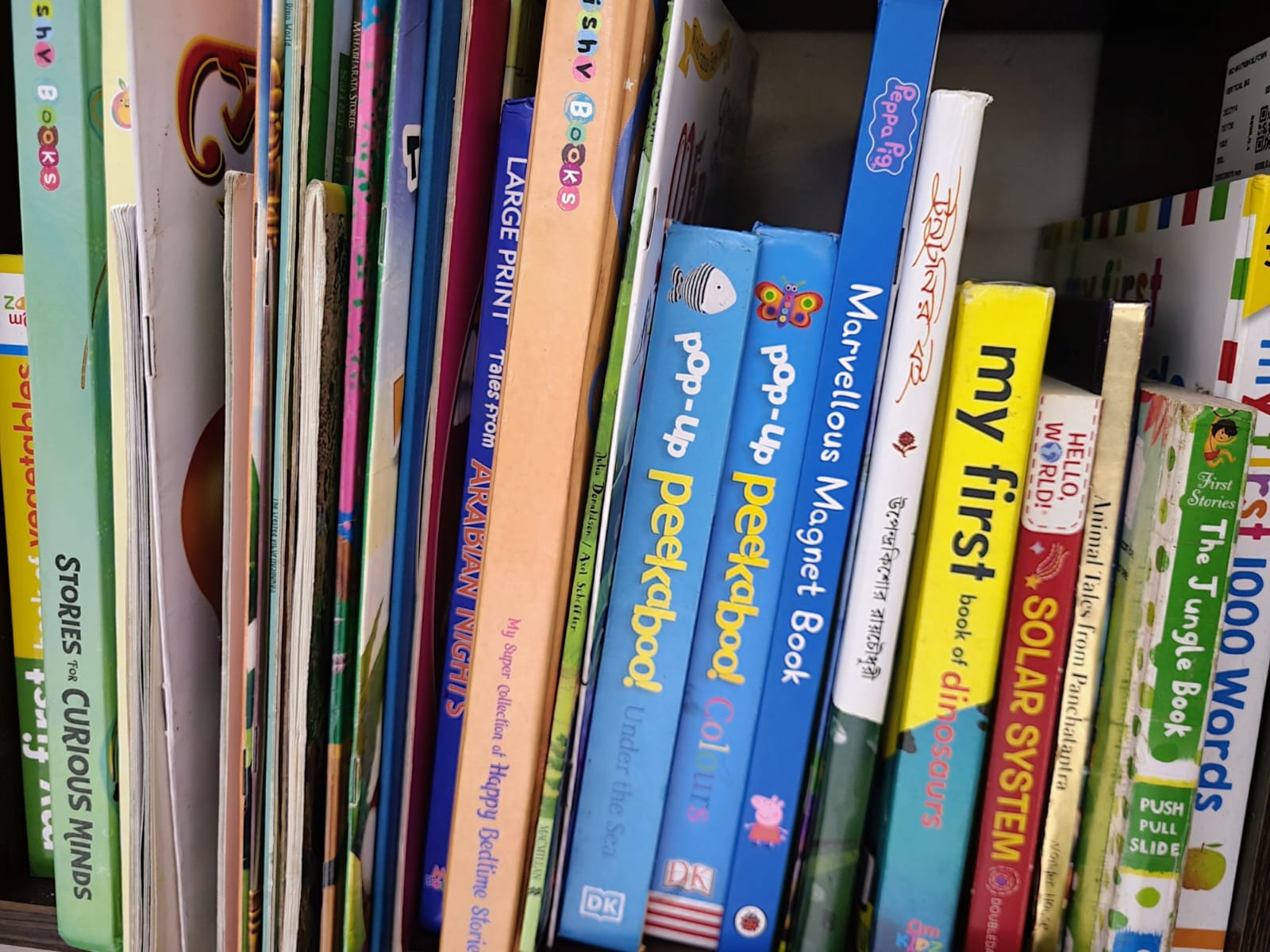
<p>Colorful picture books. Big illustrations. Simple stories. Books that felt like toys.</p>

<p>At first, she didn’t “read.” or showed much interest. She flipped pages. Pointed at pictures. Asked questions. That was enough. Slowly, something changed.</p>

<p>She began picking up books on her own and bringing them to us:</p>
<blockquote>
  <p>“Can you tell me this story?”</p>
</blockquote>

<p>That moment matters more than any rule you can enforce.</p>

<p><img src="/assets/post-assets/2025/12/image-1.jpeg" alt="Children's books that helped make reading feel more inviting" /></p>

<hr />

<h2 id="follow-their-curiosity-not-a-curriculum">Follow Their Curiosity, Not a Curriculum</h2>

<p>We noticed early that she was drawn to certain themes.</p>

<p>Dinosaurs. The solar system. Mermaids.</p>

<p>So we leaned into it.</p>

<p>We didn’t try to diversify too early or “balance” her reading. We simply bought more books around what she already loved.</p>

<p>That did two things:</p>
<ul>
  <li>It made books feel <em>relevant</em> to her world</li>
  <li>It kept her coming back for more</li>
</ul>

<p>Today, she casually talks about planets and dinosaurs in ways that surprise us for her age.</p>

<p>Not because we taught her. Because she explored it through books.</p>

<hr />

<h2 id="reading-became-a-shared-experience">Reading Became a Shared Experience</h2>

<p>At this age, reading is not a solo activity. It’s a relationship. We sit with her. We narrate stories. We exaggerate voices. We pause and ask questions.</p>

<p>Sometimes we don’t even follow the exact text. We build our own version of the story based on the pictures. That freedom matters. Books stopped being something “to read correctly” and became something to <em>experience together</em>.</p>

<hr />

<h2 id="we-changed-our-behavior-first">We Changed Our Behavior First</h2>

<p>This part is easy to overlook. We reduced our own phone usage in front of her. Not perfectly. But consciously.</p>

<p>She sees:</p>
<ul>
  <li>I read books regularly</li>
  <li>I buy books often</li>
  <li>I talk about what I’m reading with my wife</li>
</ul>

<p>No one instructed her to value books.</p>

<p>She observed it.</p>

<p>Children don’t follow instructions as much as they follow patterns.</p>

<hr />

<h2 id="what-research-says-about-early-reading-habits">What Research Says About Early Reading Habits</h2>

<p>Our experience aligns closely with what child development research has been saying for years.</p>

<h3 id="1-language-development-improves-early">1. Language Development Improves Early</h3>

<p>Studies show that children exposed to regular reading interactions develop stronger vocabulary and communication skills, even before they can read independently.</p>

<h3 id="2-attention-span-gets-stronger">2. Attention Span Gets Stronger</h3>

<p>Books require slower engagement compared to fast-paced digital content. Early reading exposure is linked to improved focus and sustained attention.</p>

<h3 id="3-imagination-expands-naturally">3. Imagination Expands Naturally</h3>

<p>Books leave room for interpretation. This encourages children to visualize, imagine, and build their own narratives.</p>

<h3 id="4-emotional-understanding-deepens">4. Emotional Understanding Deepens</h3>

<p>Stories introduce characters, emotions, and situations that help children develop empathy and emotional awareness.</p>

<hr />

<h2 id="making-reading-a-habit-without-forcing-it">Making Reading a Habit (Without Forcing It)</h2>

<p>If there’s one thing I’ve learned, it’s this: You cannot <em>force</em> a child to love books. But you can make it easy for them to fall in love with it.</p>

<p>Here’s what helped us:</p>

<h3 id="keep-books-accessible">Keep Books Accessible</h3>
<p>Books are within her reach, not stored away.</p>

<h3 id="dont-over-structure-it">Don’t Over-Structure It</h3>
<p>No fixed “reading schedule pressure.” Just natural moments.</p>

<h3 id="repeat-stories-without-complaining">Repeat Stories Without Complaining</h3>
<p>Yes, the same book again. And again. That repetition builds comfort.</p>

<h3 id="let-them-lead">Let Them Lead</h3>
<p>If she wants dinosaurs every day, it’s dinosaurs every day.</p>

<h3 id="replace-dont-remove">Replace, Don’t Remove</h3>
<p>Instead of saying “no phone,” we offer a book.</p>

<hr />

<h2 id="what-stayed-with-me">What Stayed With Me</h2>

<p>The shift was not dramatic. It was gradual, almost invisible. But one day, I noticed this:</p>

<p>She had a choice between a screen and a book.<br />
She picked the book. That’s when we knew something had worked.</p>

<hr />

<h2 id="final-thoughts">Final Thoughts</h2>

<p>We often worry about reducing screen time as if it’s a battle to win. It doesn’t have to be. You don’t need strict bans or complicated systems.</p>

<p>You just need to:</p>
<ul>
  <li>Show the alternative</li>
  <li>Be part of the experience</li>
  <li>Model the habit</li>
</ul>

<p>Children don’t just learn from what we tell them. They learn from what we live.</p>

<hr />

<h2 id="references">References</h2>

<p>My wife and me used to do a lot of research on child psycology and development. Here are some of our bookmarked resources that informed our parenting choices.</p>

<ol>
  <li>
    <p>American Academy of Pediatrics (2014). <em>Literacy Promotion: An Essential Component of Primary Care Pediatric Practice</em>. Pediatrics. <a href="https://publications.aap.org/pediatrics/article/134/2/404/32984/Literacy-Promotion-An-Essential-Component-of">Read source</a></p>
  </li>
  <li>
    <p>Bus, A. G., Van Ijzendoorn, M. H., &amp; Pellegrini, A. D. (1995). <em>Joint book reading makes for success in learning to read: A meta-analysis on intergenerational transmission of literacy</em>. Review of Educational Research. <a href="https://journals.sagepub.com/doi/10.3102/00346543065001001">Read source</a></p>
  </li>
  <li>
    <p>Mol, S. E., &amp; Bus, A. G. (2011). <em>To read or not to read: A meta-analysis of print exposure from infancy to early adulthood</em>. Psychological Bulletin. <a href="https://psycnet.apa.org/record/2010-22616-001">Read source</a></p>
  </li>
  <li>
    <p>Mar, R. A., Oatley, K., &amp; Peterson, J. B. (2009). <em>Exploring the link between reading fiction and empathy</em>. Journal of Research in Personality. <a href="https://www.sciencedirect.com/science/article/abs/pii/S0092656608001519">Read source</a></p>
  </li>
  <li>
    <p>OECD (2010). <em>PISA Results: Learning to Learn - Student Engagement, Strategies and Practices</em>. <a href="https://www.oecd.org/pisa/pisaproducts/48852630.pdf">Read source</a></p>
  </li>
</ol>]]></content><author><name>OpenLeaf (Anonymous)</name><email>openleaf.support@gmail.com</email></author><category term="Reflections" /><category term="parenting" /><category term="children and books" /><category term="screen time" /><category term="reading habit" /><summary type="html"><![CDATA[A practical reflection on the small, consistent changes that helped my four-year-old choose books over screens and build a lasting love of reading.]]></summary></entry><entry><title type="html">Announcing the OpenLeaf Mobile App for Free Ebooks</title><link href="https://openleafsupport.github.io/announcements/2025/11/15/OpenLeaf-mobile-app-announcement-for-free-ebooks.html" rel="alternate" type="text/html" title="Announcing the OpenLeaf Mobile App for Free Ebooks" /><published>2025-11-15T00:00:00+00:00</published><updated>2025-11-15T00:00:00+00:00</updated><id>https://openleafsupport.github.io/announcements/2025/11/15/OpenLeaf-mobile-app-announcement-for-free-ebooks</id><content type="html" xml:base="https://openleafsupport.github.io/announcements/2025/11/15/OpenLeaf-mobile-app-announcement-for-free-ebooks.html"><![CDATA[<p>I’m thrilled to share that I’ve started working on <strong>OpenLeaf</strong>, a mobile application dedicated to bringing the power of free ebooks to readers everywhere.</p>

<h2 id="what-is-openleaf-app">What is OpenLeaf App?</h2>

<p>OpenLeaf is a mobile app built to provide a clean, distraction-free reading experience for thousands of free ebooks available through the <a href="https://www.gutenberg.org/">Project Gutenberg library</a>. It’s designed for readers who want quality literature without the clutter, ads, or distractions of modern digital platforms.</p>

<h2 id="timeline">Timeline</h2>

<p>The app will be ready in a few months and will launch first on the <strong>Google Play Store</strong> for Android users. This initial release will help us understand how the reading community engages with the app and what features matter most to you.</p>

<h2 id="ios-coming-next">iOS Coming Next</h2>

<p>Based on the response and interest from our reading community, I will then begin work on an iOS version of the app. Your feedback during the Android launch will directly shape the iOS development roadmap.</p>

<h2 id="stay-tuned">Stay Tuned</h2>

<p>This is just the beginning of the OpenLeaf journey. Keep an eye on this space as we move toward launch, and thank you for your support in building a better reading experience for the world.</p>

<p>Happy reading,
With OpenLeaf</p>]]></content><author><name>OpenLeaf (Anonymous)</name><email>openleaf.support@gmail.com</email></author><category term="announcements" /><category term="openleaf" /><category term="mobile-app" /><category term="project-gutenberg" /><category term="free-ebooks" /><summary type="html"><![CDATA[I'm excited to announce that I've started working on OpenLeaf, a mobile app designed to bring free ebooks from Project Gutenberg to readers in a clean, distraction-free experience.]]></summary></entry></feed>