
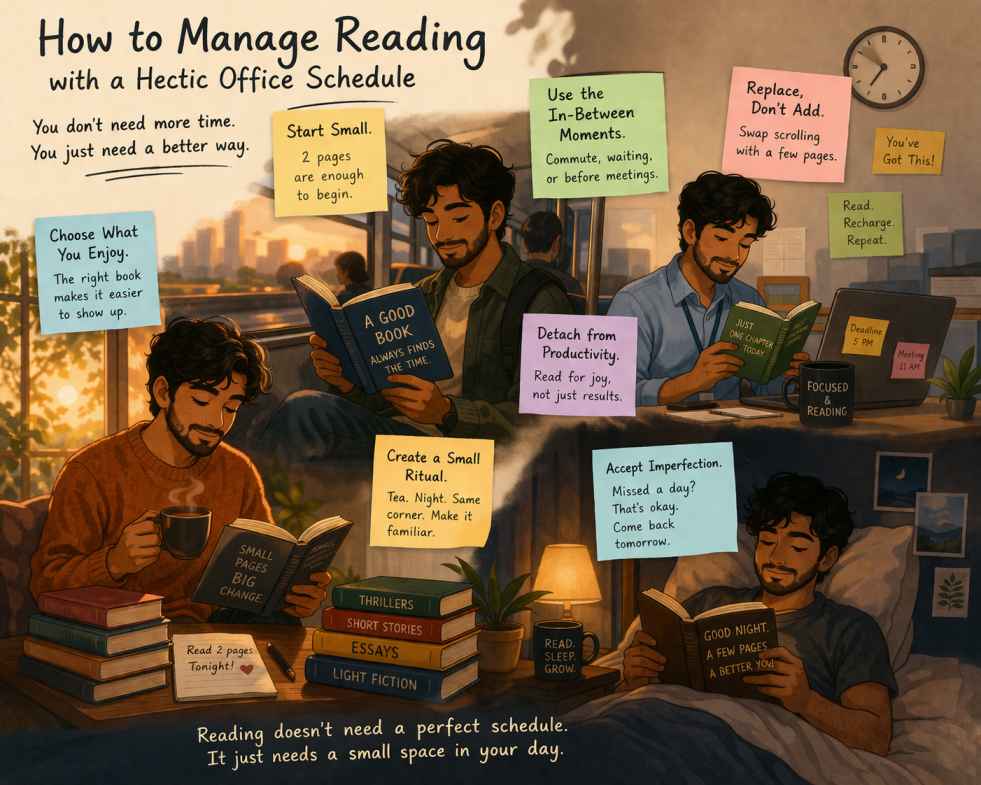
There was a time when reading felt effortless.
You picked up a book, got lost in it, and hours passed without noticing. Then work happened. Deadlines, meetings, context switching, mental fatigue. Slowly, reading moved from something natural to something you should be doing. And that shift is where most people get stuck.
Because once reading becomes another task on your to-do list, it quietly starts disappearing. The problem is not time. It is how we relate to reading within the time we already have.
The Real Problem Isn’t Time, It’s Energy
After a long workday, your brain is not looking for depth.
It wants ease. That is why you end up scrolling instead of reading. Not because you lack discipline, but because scrolling asks nothing from you.
Reading, on the other hand, needs attention. And attention is already drained. So instead of forcing reading into your schedule, the better question is:
How do you make reading feel lighter than everything else competing for your attention?
Stop Waiting for “Free Time”
One of the biggest traps is thinking: “I will read when I get free time.”
That time rarely comes. Work expands. Life fills the gaps. And by the time you are done with everything, you are too tired to read. Reading does not need free time. It needs small, intentional pockets.
A few realistic examples that I follow sometimes:
- 5–10 minutes before any meeting starts
- A few pages during commute
- Waiting time between tasks
- Just before sleeping
These moments already exist in your day. You just need to notice them.
Lower the Bar More Than You Think
Imagine your goals are:
- 30 minutes a day
- 20 pages per session
It will feel heavy on busy days. Instead, reduce it to something almost effortless:
- 2 pages
- 1 section
- Even a single paragraph
This works because it removes resistance. It happens to me and I am sure with every individual when I do not get time for reading at all. I just read a single page and that’s it. But over time, it adds up. Sometime a book takes longer time to finish but I finish it because I know I read at least 1 page a day.
Some days, you will stop there.
Some days, you will continue without realizing it.
But the important part is this: you showed up.
Replace, Don’t Add
Trying to add reading to an already packed schedule rarely works. Replacing something does.
You already have a habit: Pick up phone → unlock → check something random → put it down
Instead of breaking that habit, redirect it. Keep a book:
- On your desk
- Near your bed
- Or on your phone
Next time you unlock your phone, open a reading app instead of a social app. Even if you read just one page, it counts.
This idea is something I’ve personally leaned on heavily, especially while stepping away from social media and trying to rebuild my reading rhythm.
Choose the Right Kind of Books for Your Work Phase
Not every book fits every phase of life.
After a long day of work, dense or heavy books can feel exhausting.
That does not mean you are losing your reading habit.
It just means you need to adapt your choices.
Try:
- Short stories
- Light fiction
- Engaging thrillers
- Essays or bite-sized non-fiction
You can always return to heavier books later. Reading should meet you where you are, not where you think you should be. Personally I keep on changing genre all the time. If I am not able to finish a book, I just switch to another genre. For example, if I am not able to finish a fiction book, I switch to a non-fiction book or a thriller book. And that’s it. No hard feelings.
Detach Reading from Productivity
There is a subtle pressure to make reading “useful” to learn something, to improve something, to finish more books.
That mindset quietly turns reading into work and your brain resists it. It is okay to:
- Read slowly
- Re-read pages
- Not finish books
- Read purely for enjoyment
Reading doesn’t always have to justify itself. Sometimes, it just needs to feel good.
There have been many times when I’ve taken a month or more to finish a book, and other times when I’ve finished one in just three days. Both are completely okay!
Create a Small Ritual
You don’t need a perfect setup. Just a small, repeatable signal. It could be:
- Reading with your evening tea
- Reading before sleeping
- Sitting in the same corner every night
Over time, your brain starts associating that moment with reading and it becomes easier to begin. Not because you forced it, but because it feels familiar.
A Closing Thought
A hectic schedule does not take reading away from you. It only changes how reading fits into your life.
When you stop treating reading as a task and start treating it as a quiet pause, something shifts. It no longer competes with your day. It becomes a small space within it. And sometimes, that small space is exactly what you needed.
Public comments
Prefer to leave a public note here? You can comment below using GitHub Discussions via Giscus.